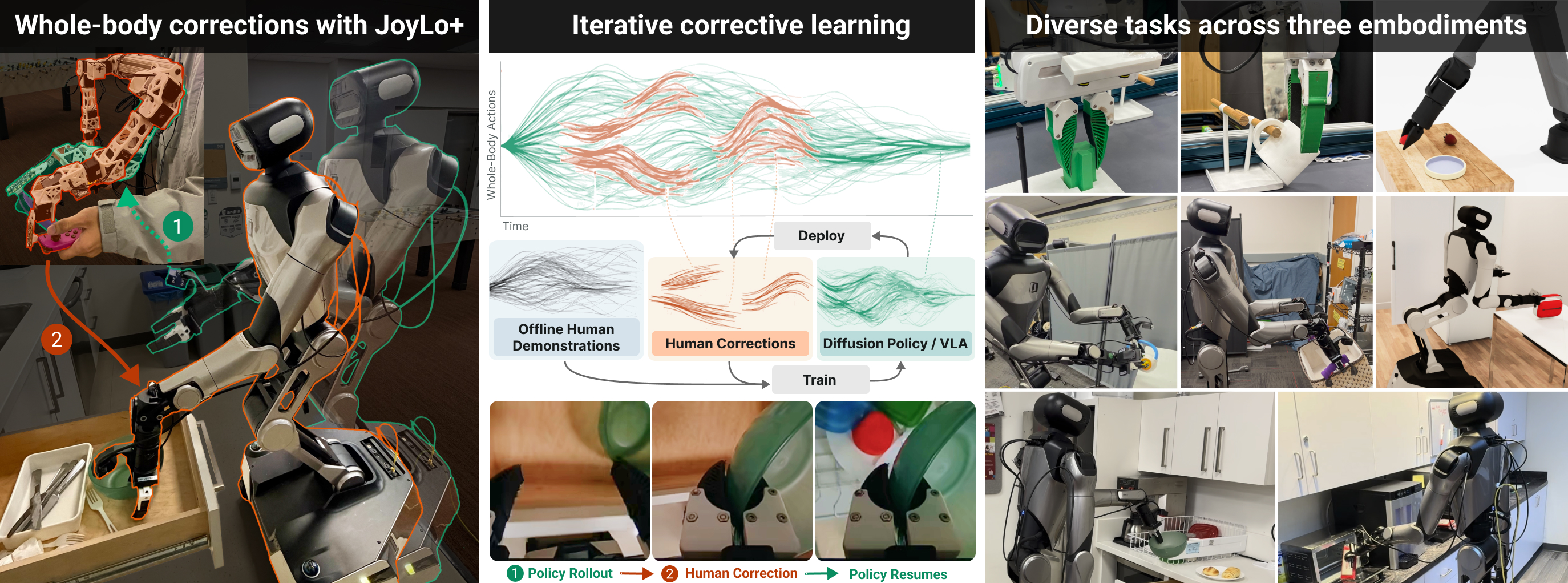
Policies trained offline from teleoperated demonstrations can degrade outside their training distribution. This gap is particularly acute in long-horizon whole-body mobile manipulation, where long horizons amplify compounding errors and coordinated arm, torso, and base motion makes exhaustive demonstration coverage impractical. We introduce I3L, an integrated hardware and learning system that couples targeted whole-body correction with iterative policy refinement to address this last-mile reliability gap. Its low-cost, open-source JoyLo+ interface uses policy-tracking leader arms and touch-triggered takeover to enable coordinated corrections across the arms, torso, and mobile base, while repeated deployment and retraining allow operators to target failures of the updated policy. We evaluate I3L across three robot embodiments and eight simulated and real-world tasks, including four long-horizon whole-body mobile manipulation tasks. Controlled simulation comparisons show that four-round HG-DAgger achieves the highest final success on both simulation tasks. Under this protocol, I3L improves autonomous success over the base policies by an average of 68.3 percentage points and achieves at least 90% success on every task, outperforming demonstration-only training by 35.6 percentage points on average under matched training-trajectory budgets. Across four rounds, task-averaged takeover duration per episode decreases by 72%. Together, these results show that I3L helps close the last-mile gap between offline training and reliable deployment and provides practical insights into collecting and using corrections for long-horizon whole-body mobile manipulation.
Explore the leader arms in 3D. The hardware overview is available below.
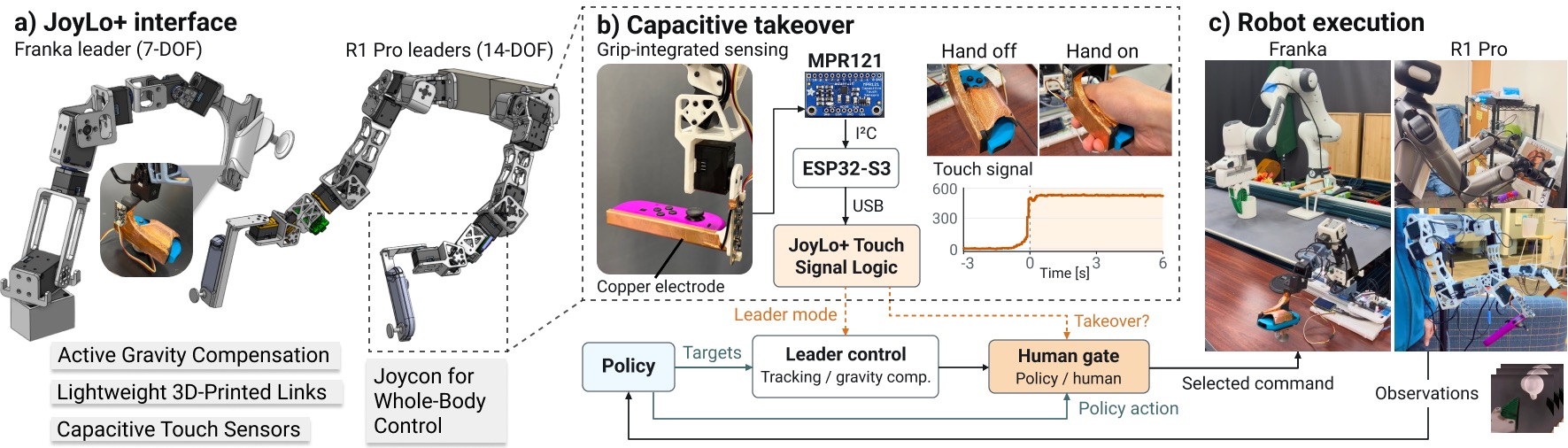
JoyLo+ correction interface in single-arm (Franka) and dual-arm (R1 Pro) configurations.
JoyLo+ builds on GELLO's kinematic leaders and JoyLo's actuated interface to let an operator step in during autonomous execution.
| Component | Unit cost | Single-arm quantity | |
|---|---|---|---|
| Franka | R1 Pro | ||
| XM430-W350-T servo | $220 | 3 | 4 |
| XC330-M288-T servo | $50 | 4 | 3 |
| U2D2 USB adapter | $30 | 2 | 2 |
| Power supply (12 V / 5 V) | $25 | 2 | 2 |
| 3D-printed links (set) STL downloads: Franka ZIP · R1 Pro ZIP Assembly models: Franka · R1 Pro | $15 | 1 | 1 |
| Joy-Con pair (L+R) | $80 | 1 | 1 |
| Adafruit MPR121 touch sensor | $7.95 | 1 | 1 |
| LILYGO T-Display S3 | $9.54 | 1 | 1 |
| Conductive copper tape | $5 | 1 | 1 |
| Estimated total (USD) | $1,087.49 | $1,257.49 | |
Single-arm JoyLo+ cost estimates (USD). Each column covers one seven-joint leader and the listed accessories. Robot, tax, shipping, cabling, fasteners, bearings, and mounting hardware are excluded. Vendor prices may differ. Power-supply and copper-tape links are sourcing references.
Starting from a demonstration dataset D0, each round deploys the previous policy and collects a labeled rollout dataset through JoyLo+. Under HG-DAgger filtering, only the original demonstrations and the active intervention frames from all rounds are retained for training. Pre-intervention and on-policy frames are excluded to concentrate training on human demonstrations and corrective supervision.
Each round trains from the same starting weights rather than continuing from the previous round's policy: the same pretrained checkpoint for the π0.5-based VLA, and the same initialization for diffusion policies. As earlier failures become less frequent, corrections naturally shift toward downstream stages such as transport and placement, producing an emergent failure-mode curriculum.
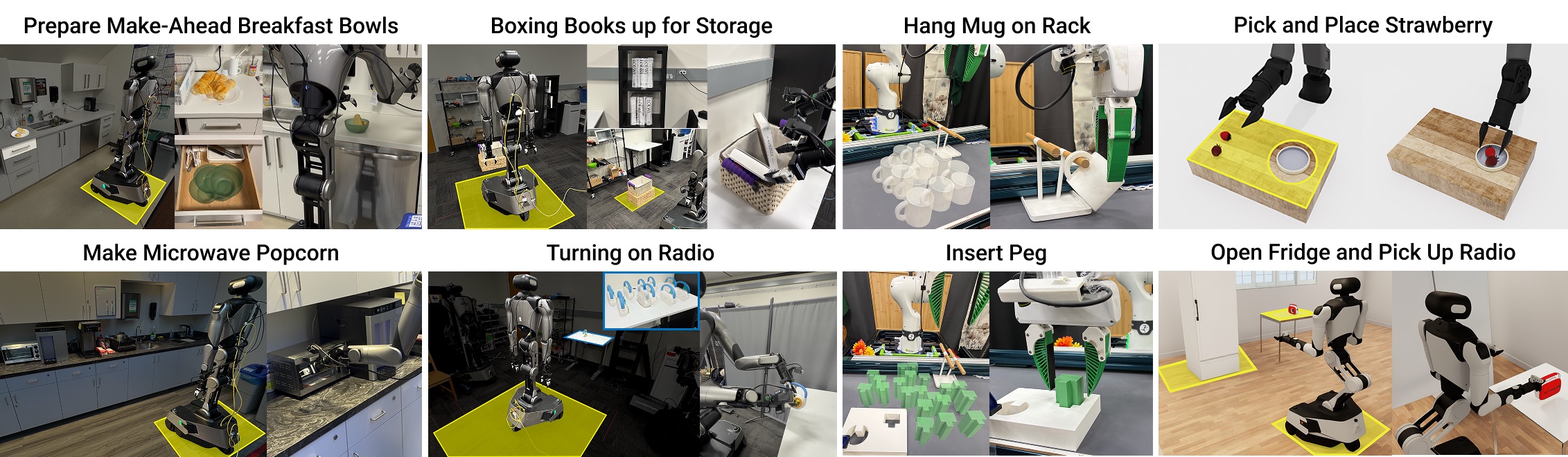
Evaluation tasks. Initial configurations and successful outcomes; yellow mats mark where the R1 Pro base and task objects are randomized.
Eight tasks on three robots: two controlled BEHAVIOR simulation tasks for comparing collection and learning strategies, two contact-rich precision tasks on Franka, and four long-horizon whole-body mobile manipulation tasks on a real R1 Pro.
| Task | Base | 100 demos | 100 corrections (ours) |
|---|---|---|---|
| Simulation | |||
| Pick-and-Place Strawberries | 53.2% | 55.6% | 92.8% |
| Open Fridge and Pick Up Radio | 39.6% | 30.4% | 90.0% |
| Real world (Franka) | |||
| Mug Hanging | 6/25 (24%) | 17/25 (68%) | 23/25 (92%) |
| Peg Insertion | 7/25 (28%) | 12/25 (48%) | 23/25 (92%) |
| Real world (R1 Pro) | |||
| Prepare Make-Ahead Breakfast Bowls | 1/25 (4%) | 19/25 (76%) | 24/25 (96%) |
| Boxing Books up for Storage | 3/25 (12%) | 13/25 (52%) | 23/25 (92%) |
| Make Microwave Popcorn | 5/25 (20%) | 20/25 (80%) | 25/25 (100%) |
| Turning on Radio | 6/25 (24%) | 14/25 (56%) | 24/25 (96%) |
Autonomous full-task success. Each base policy receives either 100 additional demonstrations or 100 corrective trajectories collected over four HG-DAgger rounds.
With the same trajectory budget, targeted corrections outperform additional demonstrations on every task and reach at least 90% autonomous success on all eight.
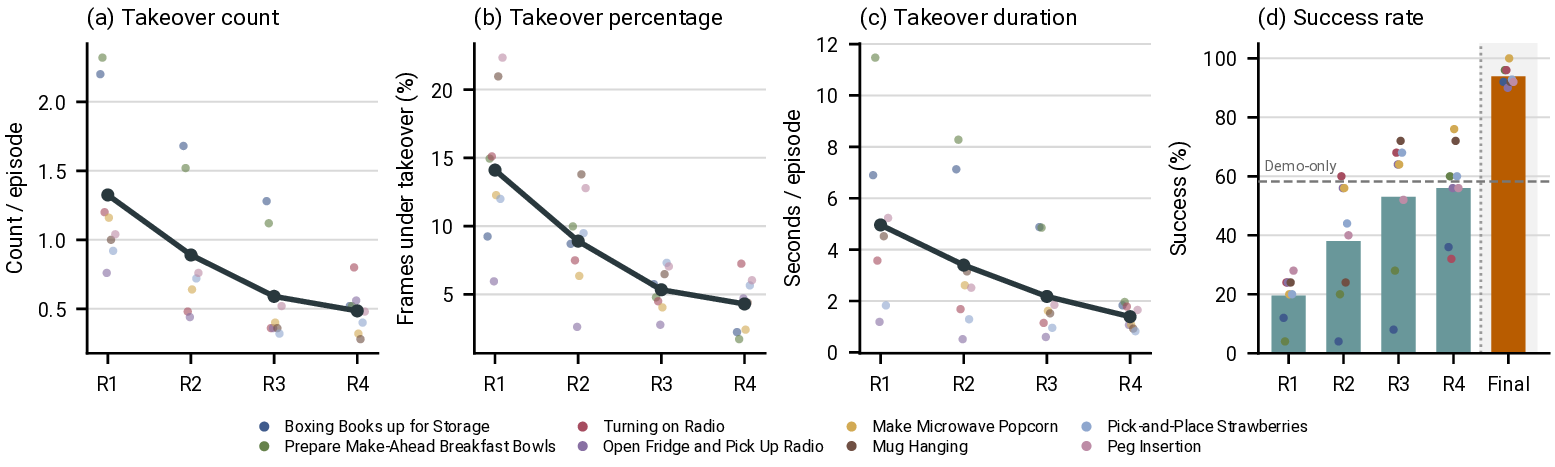
Intervention burden across correction rounds. Dots are tasks and the dark line is the task mean. In (d), rounds show takeover-free collection episodes and Final shows autonomous evaluation success.
As the policy is retrained, operators step in less often, for less of each episode, and for less time, with all three measures declining every round.
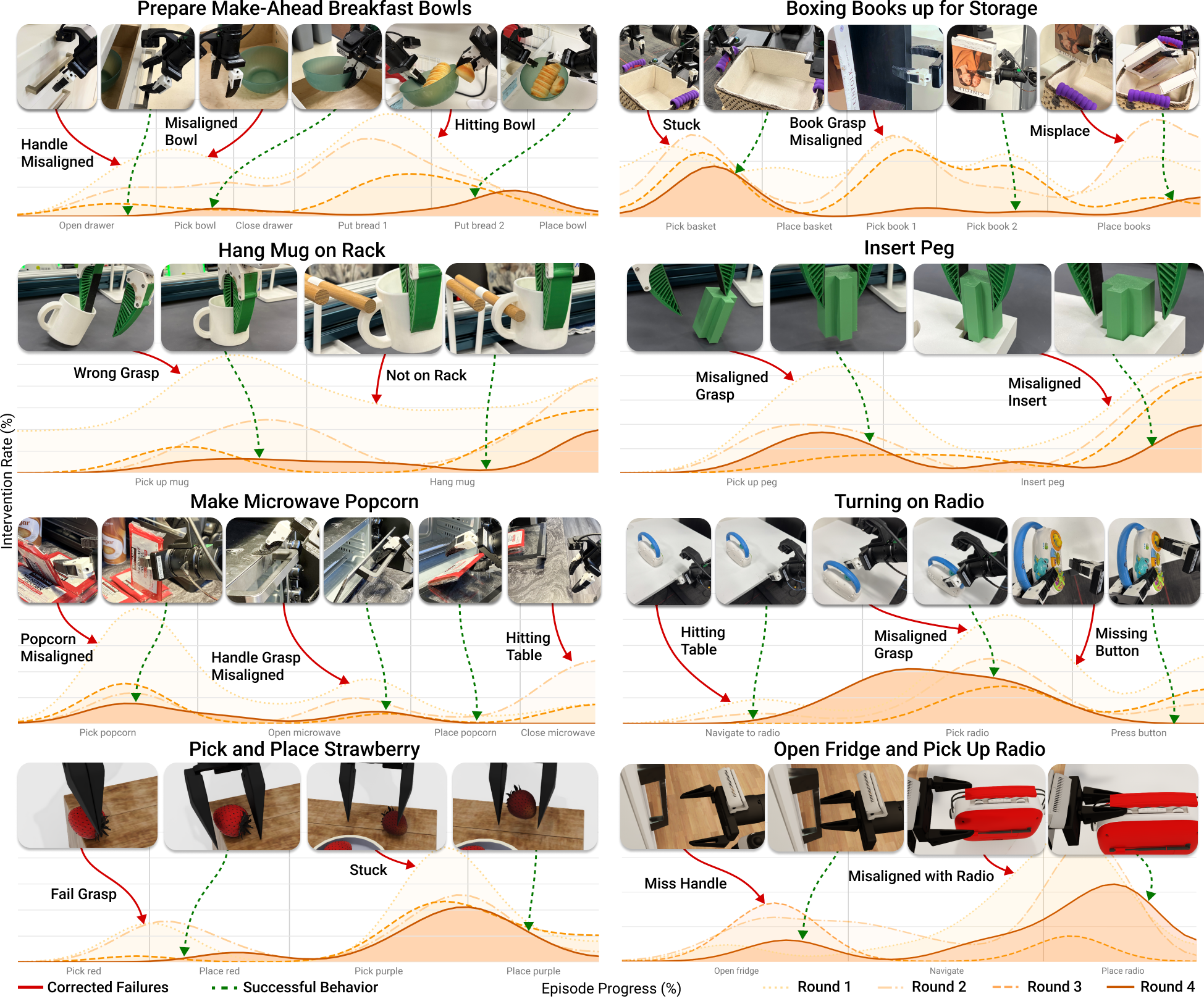
Intervention rate (%) over episode progress (%)
Red arrows: corrected failures. Green dashed arrows: successful behavior.
Where corrections happen. Intervention rate over episode progress for Rounds 1–4 (lighter is earlier). Red arrows mark corrected failures; green arrows mark successful behavior.
As early-stage failures are fixed, the remaining corrections concentrate on each task's later stages, forming an emergent curriculum over failure modes.
Example episodes with human takeover and correction. The policy drives the robot until the operator takes over through JoyLo+. The top-left badge, the robot's floor disc, and the timeline show what is controlling the robot at every frame. The JoyLo+ inset mirrors the recorded robot-arm poses, with an orange border during takeover. Click or drag the timeline to seek.
The leaders drive both arms while the JoyCon drives the torso and base, so a single takeover can coordinate the whole robot.
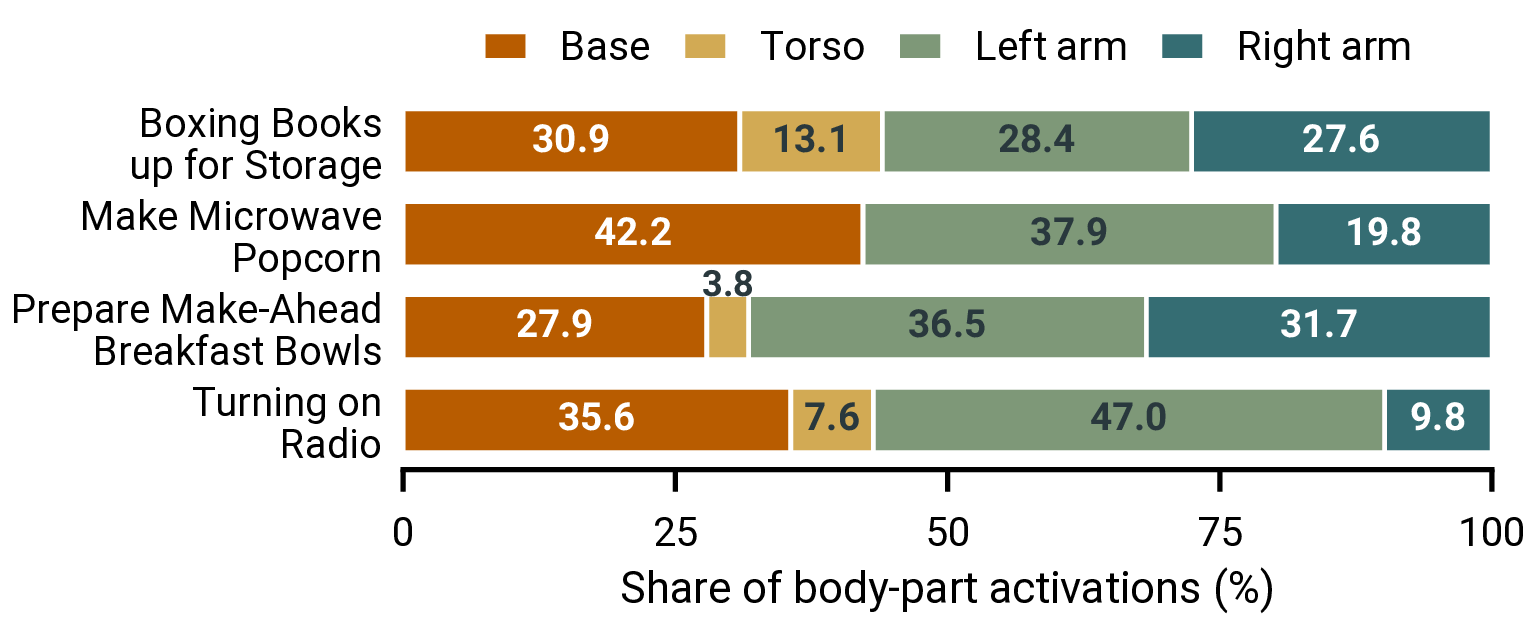
Body-part activation shares during JoyLo+ corrections, pooled over four rounds. Each part gets one vote per takeover segment once active for three consecutive frames.
Operators use this: on every task, a large share of corrections move the base rather than only the arms.
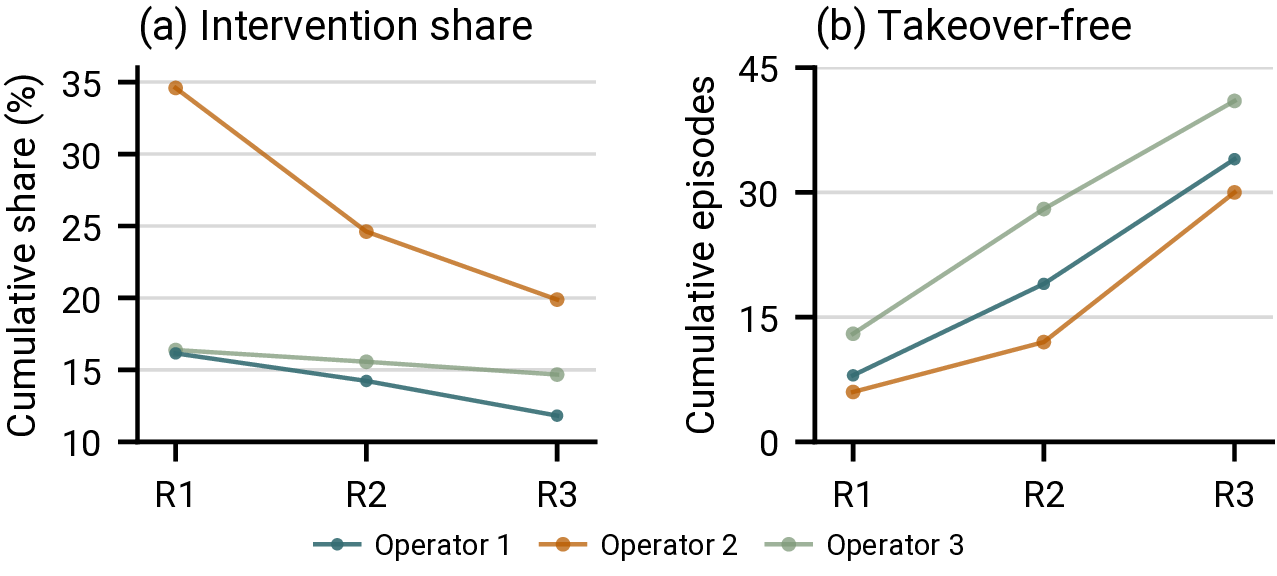
Three operators with different teleoperation experience each run three correction rounds of 25 episodes on Franka Mug Hanging, each refining their own policy.
Operator study on Franka mug hanging. (a) Cumulative fraction of timesteps under human control. (b) Cumulative takeover-free episode counts.
Intervention burden falls and takeover-free episodes accumulate for every operator, so the gains from I3L do not depend on a single expert.
| Setting | Residual | BC (all data) | SIRIUS | HG-DAgger |
|---|---|---|---|---|
| Pick-and-Place Strawberries | ||||
| Single round (100) | 45.2 | 14.8 | 76.0 | 89.2 |
| Round 1 (25) | 49.2 | 0.4 | 70.8 | 75.6 |
| Round 2 (50) | 45.6 | 1.2 | 78.8 | 88.4 |
| Round 3 (75) | 40.0 | 4.4 | 37.6 | 88.4 |
| Round 4 (100) | 46.8 | 10.8 | 78.8 | 92.8 |
| Open Fridge and Pick Up Radio | ||||
| Single round (100) | 21.6 | 79.2 | 73.2 | 80.0 |
| Round 1 (25) | 16.0 | 70.8 | 54.8 | 51.6 |
| Round 2 (50) | 24.0 | 86.4 | 68.4 | 72.4 |
| Round 3 (75) | 30.0 | 87.2 | 70.4 | 82.0 |
| Round 4 (100) | 19.6 | 88.0 | 71.6 | 90.0 |
Correction-learning comparison in simulation. Full-task success (%) over five evaluation seeds; parentheses give cumulative corrective trajectories.
Four-round HG-DAgger finishes best on both tasks, but more rounds alone do not guarantee a better policy: how corrections are learned from matters as much as collecting them.